
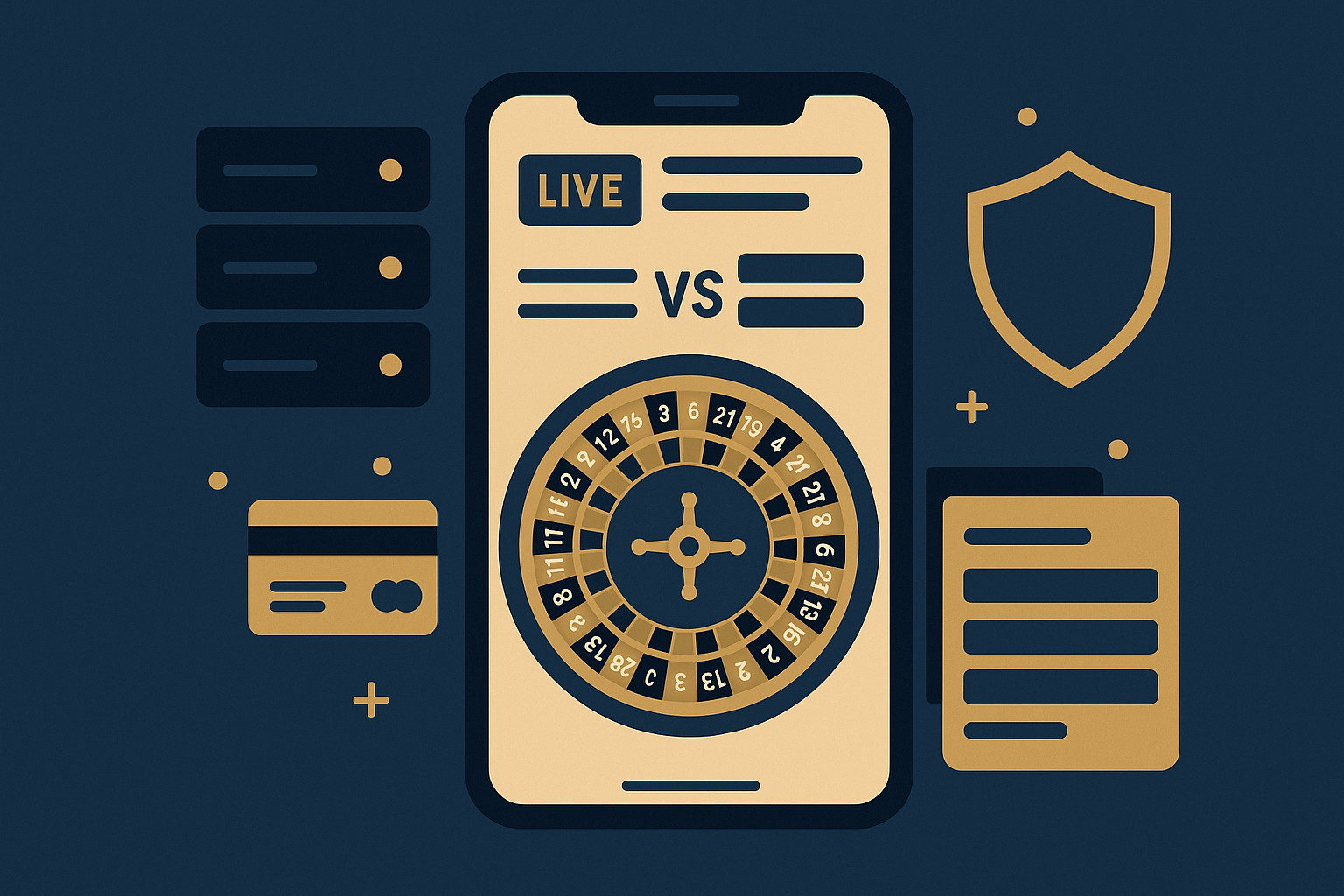
What is iGaming? (definition)
iGaming is the industry term for gambling that happens over the internet: online casino games, sports betting, poker, bingo and lottery products played on a website or mobile app for real money. The “i” is simply short for internet, the same way “e” got attached to email and e-commerce.
That’s the short iGaming definition. What makes it a distinct industry, rather than just “casinos with a website,” is how the whole thing is built. An online blackjack table isn’t a felt layout and a dealer; it’s software running on a licensed server, tested by an independent lab, connected to a payment processor, a customer database, a bonus engine, and often a game studio in another country entirely.
A few characteristics separate iGaming from its offline cousin:
- Outcomes are produced by software. Slots, virtual table games and instant-win titles use a random number generator (RNG) certified by a testing lab. Live dealer games use real cards and wheels, but everything around them (bets, payouts, limits) is handled digitally.
- It’s regulated by geography, not by building. Legality depends on where the player is physically sitting, which is why apps check your location before letting you bet.
- The margins are transparent by design. Every game publishes a return to player (RTP) figure, and the house edge is the flip side of it. A 96% RTP slot has a 4% house edge, meaning that over millions of spins the game keeps about ₹4 of every ₹100 wagered, or $4 of every $100. That average says nothing about any single session.
- Data drives everything. Operators track wagering, retention and bonus behavior at a level of detail no land-based floor can match.
iGaming vs online gambling: what’s the difference?
In practice, very little. “Online gambling” is what players say; “iGaming” is what the people who build, license, supply and market it say. The terms cover the same activity, but they carry different flavor.
Three wrinkles are worth knowing:
- In US regulatory shorthand, “iGaming” often means online casino specifically. When a state legislature or an operator’s earnings call refers to “iGaming revenue,” they usually mean online slots and table games, with online sports betting (OSB) reported separately. Read the context.
- “Gaming” is the industry’s preferred word for gambling. It’s not a euphemism the sector invented yesterday; state regulators are literally named things like the Michigan Gaming Control Board.
- Video gaming is a different business. Esports, mobile puzzle games and social casino apps with no cash payout aren’t iGaming, even though the vocabulary overlaps. The dividing line is whether you can wager real money and withdraw real money.
So if someone asks whether iGaming is the same as gambling: yes. It is gambling, delivered online, and it carries the same risk of loss. Anyone framing iGaming as an income stream is selling something.
Types of iGaming products
The industry splits into four main verticals. Most large operators run at least two of them under one account and one wallet.
Online casino games
The biggest category by game count. Slots dominate, typically with RTPs around 94–97% and a volatility profile that tells you how the wins are distributed: high volatility means rarer but larger payouts, low volatility means smaller and more frequent ones. Volatility doesn’t change RTP.
Alongside slots you get digital table games (blackjack, roulette, baccarat, video poker), live dealer studios where a human dealer is streamed in real time, and game show formats like wheel-based titles that blend a live host with digital multipliers. Crash games, where a multiplier climbs from 1.00× until it crashes and you have to cash out first, have become a category of their own.
Sports betting
Wagering on outcomes in sports, priced by a sportsbook. In the US, odds are usually shown American style (−150, +220) rather than decimal, but the maths is identical: the price implies a probability, and the book builds in a margin, sometimes called the overround or the vig. In-play betting, same-game parlays and player props now generate a large share of handle. Daily fantasy sports sits adjacent to this vertical and is regulated differently in many states.
Online poker
Player versus player, with the operator taking a rake rather than betting against you. Cash games, sit-and-gos and multi-table tournaments all run online. Poker’s economics depend on liquidity: you need enough players at the tables to fill games, which is why interstate compacts matter so much in the US market.
Bingo and lottery
Online bingo is a smaller but sticky vertical, strong in the UK and popular for its chat-room social element. iLottery covers state lottery products sold online, including draw tickets and instant-win scratch-style games. Several US state lotteries sell online, and their rules are separate from casino and sportsbook licensing.
How the iGaming industry works: key players
The brand on the app is rarely the company that built the games, the platform or the payment rails. Four groups make up most of the ecosystem.
| Role | What they actually do | How they get paid |
|---|---|---|
| Operator | Holds the licence, owns the brand, manages players and pays out winnings | Gross gaming revenue (player losses) minus tax and costs |
| Platform provider | Supplies the core software: wallet, account system, game aggregation, reporting | Revenue share or fixed licensing fees |
| Game developer / studio | Designs and certifies the games themselves | Revenue share per game, usually a slice of that game’s GGR |
| Affiliate / marketing partner | Sends traffic and new players through reviews, content and media | Revenue share, cost per acquisition, or hybrid deals |
Operators: the brands players know
Operators are the customer-facing businesses: they hold the state or national licence, take deposits, set bonus terms, run KYC checks and are legally responsible for paying withdrawals. In the US, an operator usually needs a partnership with a land-based casino licensee in the state to go live at all, which is why online brands are so often tied to a physical property.
Platform providers: the technology
Platform providers sell the plumbing. A player account management system tracks balances, bonuses, limits and self-exclusions. An aggregator connects hundreds of game studios through a single integration, so an operator doesn’t have to negotiate and build one-by-one. Companies in this layer include Playtech, Light & Wonder’s OpenBet, Bragg Gaming and IGT’s digital division. Some large operators, notably FanDuel and DraftKings, run their own in-house technology instead.
Game developers and content suppliers
Studios build the games and put them through independent testing labs like GLI or BMM Testlabs before a regulator will approve them. Evolution dominates live dealer content. Slot names US players will recognise include IGT, Light & Wonder, NetEnt, Pragmatic Play, Play’n GO and Everi. A studio typically earns a revenue share on its own titles, which is why the same slot appears across dozens of competing casinos.
Affiliates and marketing partners
Affiliates are publishers, comparison sites, content creators and media companies that send players to operators and get paid for it. It’s a legitimate and heavily regulated slice of the industry: in licensed US states, affiliate marketing must follow advertising rules on age targeting, responsible gambling messaging and claims. Affiliates cannot promise winnings, and neither can operators.
What technology powers iGaming platforms?
Six layers do most of the work:
- RNG and game servers. A certified random number generator determines each spin or hand. Results are independent, so previous outcomes tell you nothing about the next one. There is no “hot” or “cold” slot.
- Live streaming. Live dealer games run from purpose-built studios with multiple camera angles, optical character recognition to read cards and wheel results, and low-latency video delivered to thousands of players at once.
- Geolocation and identity. US operators use device location checks plus KYC document verification to confirm a player is of legal age and physically inside a licensed state.
- Payments. Card processing, ACH and bank transfers, PayPal, prepaid play+ cards and cash-at-cage options, all wired into fraud screening and AML monitoring.
- Mobile. Most real-money play in regulated markets happens on phones, which is why HTML5 games and native apps, not desktop clients, drive product decisions.
- Responsible gambling tooling. Deposit, loss and session limits, cool-off periods, reality checks and links into state self-exclusion registers are a licensing requirement, not an optional feature.
Crypto-native sites add another concept: provably fair games, where cryptographic seeds and hashes let a player verify after the fact that a round’s result wasn’t tampered with. That’s a different trust model to RNG certification by a lab, not a better payout.
iGaming examples: popular brands and products
To make it concrete, here’s what the industry looks like from a US player’s screen:
- Operators: FanDuel, DraftKings, BetMGM, Caesars, BetRivers, Bet365, Fanatics Sportsbook, Borgata Online and Golden Nugget Online.
- Live casino products: Evolution’s Lightning Roulette and its live blackjack tables, streamed from studios including facilities in New Jersey, Pennsylvania and Michigan.
- Slots: long-running titles such as Starburst from NetEnt and Cleopatra from IGT, plus mechanics-driven newer games built around Megaways-style variable ways to win.
- Poker: WSOP.com and PokerStars US, both operating under state licences.
- Sportsbook products: same-game parlays, live in-play markets, and cash-out features that let you settle a bet before the event ends.
- Lottery: state-run iLottery sites selling draw entries and instant-win games online.
The US iGaming market: current state
The US market is split in two, and the split is the single most important thing to understand. Online sports betting is legal in a large majority of states, roughly three dozen plus Washington, D.C., following the Supreme Court’s 2018 decision in Murphy v. NCAA that struck down the federal PASPA ban. Online casino gaming is legal in only a handful.
As of 2025, these are the states with legal, regulated online casino or online poker:
| State | Online casino | Launched | Primary regulator |
|---|---|---|---|
| New Jersey | Yes (casino + poker) | 2013 | Division of Gaming Enforcement |
| Delaware | Yes (casino + poker) | 2013 | Delaware Lottery |
| Nevada | Poker only | 2013 | Nevada Gaming Control Board |
| Pennsylvania | Yes (casino + poker) | 2019 | Pennsylvania Gaming Control Board |
| West Virginia | Yes (casino + poker) | 2020 | West Virginia Lottery |
| Michigan | Yes (casino + poker) | 2021 | Michigan Gaming Control Board |
| Connecticut | Yes (casino, no poker) | 2021 | Dept. of Consumer Protection |
| Rhode Island | Yes (casino) | 2024 | Rhode Island Lottery / DBR |
New Jersey, Michigan and Pennsylvania are the heavyweights by online casino revenue, and each state regulator publishes monthly revenue reports you can check yourself. The American Gaming Association also publishes national commercial gaming revenue data if you want the aggregate picture. [Editor: link to the current AGA commercial gaming revenue tracker and relevant state regulator reports.]
Two structural details shape everything:
- Licensing runs through land-based casinos. Most states require an online brand to operate under a partnership with an in-state casino licensee, which limits how many skins can launch.
- Tax rates vary wildly. Online casino tax rates are far higher in some states than others, which affects how aggressive bonuses and marketing can be in each market.
Expansion has been slower than sports betting supporters expected. Online casino bills come up regularly in states like New York, Illinois, Maryland and Ohio, and they run into opposition from tribal gaming interests, land-based operators worried about cannibalisation, and the Wire Act’s murky application to interstate transmission. Meanwhile, sweepstakes casinos and offshore sites operate in a grey area outside state regulation; they don’t carry the same consumer protections, dispute resolution or guaranteed payout obligations as a licensed operator, and several states have moved to restrict them.
If you’re exploring the industry as a career or affiliate path, the practical takeaway is that the US is not one market. It’s a state-by-state patchwork of separate licences, separate tax regimes and separate player pools. Start with our state-by-state guide to legal online casinos and our introduction to sports betting odds if you want the detail behind the summary above.
FAQ
Is iGaming the same as gambling?
Yes. iGaming is real-money gambling conducted online. The term is industry shorthand, not a different activity, and the risk of losing money is exactly the same.
What are the main types of iGaming?
Online casino games (slots, table games, live dealer), sports betting, online poker, and bingo plus lottery products. Most large operators run casino and sportsbook side by side.
What technology powers iGaming platforms?
Certified random number generators, live-streaming studios, player account management platforms, game aggregators, geolocation and KYC checks, payment processing, and responsible gambling tools.
What are examples of iGaming products?
An online slot like Starburst, a live Lightning Roulette table, a same-game parlay on a sportsbook app, a poker tournament on WSOP.com, or an online instant-win lottery game.
Is iGaming legal everywhere in the US?
No. Online sports betting is legal in most states, but regulated online casino gaming is live in only a handful, listed in the table above. Always check your own state’s current rules before depositing.
A note on playing responsibly
Every product described here carries a house edge, which means the operator wins over time by design. Gambling is entertainment with a cost, not a way to make money. Set deposit and loss limits before you play, use the cool-off and self-exclusion tools your operator is required to offer, and never wager money you need for something else. If gambling is causing problems for you or someone close to you, help is available in the US through the National Problem Gambling Helpline at 1-800-GAMBLER. You must be of legal age in your state to gamble.