
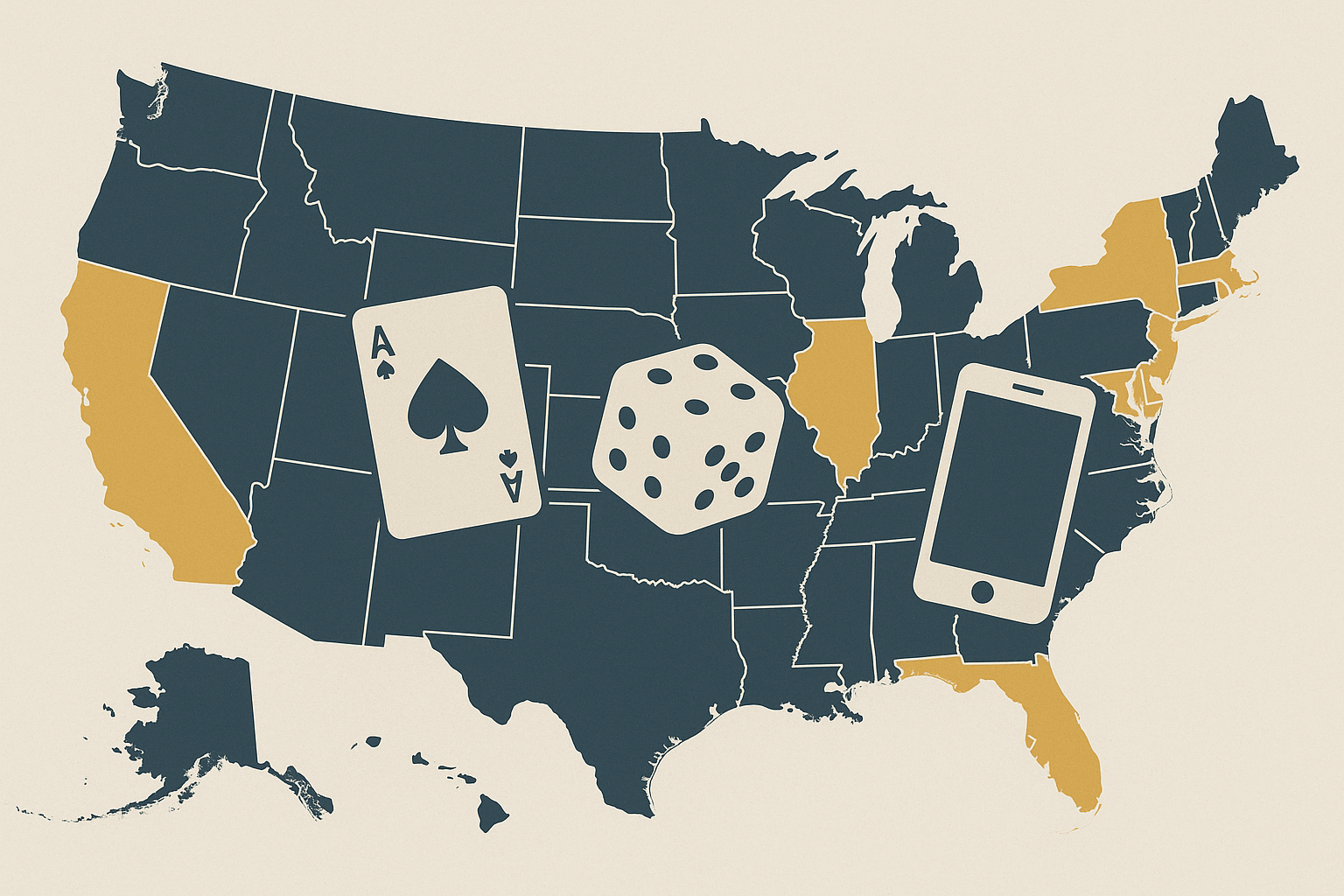
What is iGaming and is it legal in the US?
Short answer: iGaming is legal in a small number of US states and unavailable in most of the rest. Seven states currently run regulated online casino markets, while sports betting, which follows a separate legal track, is available online in around 30 states plus Washington, D.C. There is no federal law that licenses online casino play, so whether it is legal for you depends entirely on the state you are physically sitting in.
“iGaming” in US industry usage means real-money online casino games: slots, blackjack, roulette, baccarat, video poker, live dealer tables and online poker. Some people use the word loosely to cover all online gambling, including sportsbooks, which is where a lot of confusion starts. When a state legislature debates an “iGaming bill,” it is almost always talking about online casino games, not sports wagering.
One thing to be clear about before going further: this article is informational only and not legal advice. Gambling statutes, regulations and launch dates change often, sometimes mid-session, and tribal compacts add another layer. If you need a definitive answer for your situation, check your state gaming regulator’s website or speak to a qualified attorney.
iGaming vs sports betting: key legal differences
The two markets diverged because of one court decision. In Murphy v. NCAA (2018), the Supreme Court struck down the Professional and Amateur Sports Protection Act (PASPA), the 1992 federal law that had effectively frozen sports betting outside Nevada. That ruling handed sports wagering policy back to the states, and states moved fast because the politics were easy: a visible, popular product with an obvious tax base.
Online casino gaming never had a PASPA moment, because it never had a PASPA. It was always a state-law question, and it remains one. The federal statutes that touch it work indirectly:
- The Wire Act (1961) targets the transmission of bets across state lines. Its scope was litigated in the last decade, and in 2021 the First Circuit held that it applies to sports wagering rather than to other forms of online gambling. The Department of Justice did not seek Supreme Court review.
- UIGEA (2006) does not criminalise players. It restricts payment processing for internet gambling that is already unlawful under some other state or federal law, which is why licensed operators in regulated states can process deposits normally.
- IGRA (1988) governs tribal gaming and shapes how states such as Connecticut and Michigan structured their online markets.
The practical result: legalising sports betting is now a familiar, well-trodden bill for a legislature. Legalising online casino is a harder sell, because commercial casino operators worry about cannibalising bricks-and-mortar revenue, unions worry about floor jobs, and tribal interests often hold exclusivity rights that have to be renegotiated. That gap, not federal law, is the main reason a state like New York can take billions in mobile sports bets while its residents have no legal online slots.
States where online casino gaming is legal (2025)
Seven states operate full regulated online casino markets. Nevada is a partial case: it licenses online poker but not online slots or table games.
| State | Online casino launched | Primary regulator | Notes |
|---|---|---|---|
| New Jersey | 2013 | Division of Gaming Enforcement | Largest US iGaming market; operators tied to Atlantic City licences |
| Delaware | 2013 | Delaware Lottery / Division of Gaming Enforcement | State lottery-run model with a single platform partner |
| Pennsylvania | 2019 | Pennsylvania Gaming Control Board | Casino, poker and online lottery games all regulated |
| West Virginia | 2020 | West Virginia Lottery | Interactive wagering licensed through existing casinos |
| Michigan | 2021 | Michigan Gaming Control Board | Commercial and tribal operators both licensed |
| Connecticut | 2021 | Dept. of Consumer Protection, Gaming Division | Online casino run by the Mashantucket Pequot and Mohegan tribes |
| Rhode Island | 2024 | Division of Lotteries / Dept. of Business Regulation | Single-operator market tied to the state’s casinos |
| Nevada | 2013 (poker only) | Nevada Gaming Control Board / Commission | No online slots or table games |
Online poker liquidity is shared across some of these markets through the Multi-State Internet Gaming Agreement. Nevada, Delaware and New Jersey were the original signatories, with Michigan joining later, which lets licensed poker sites pool players across state lines legally. Pennsylvania has not joined.
Every one of these markets is closed and licensed: only operators holding a state licence, usually attached to a land-based casino or tribal gaming entity, may take bets. Offshore sites that accept US players are not licensed by any state regulator, which means no state oversight of game fairness, no enforceable dispute process and no guaranteed route to recover funds.
States with sports betting only
This is the largest group by far. Dozens of states legalised sportsbooks after PASPA fell but left online casino gaming untouched. Notable examples of states with legal online sports betting and no legal online casino include:
- New York – mobile sports betting launched in January 2022 and became the highest-handle market in the country; online casino bills have been introduced repeatedly without passing.
- Illinois – online sportsbooks live since 2020; iGaming legislation has stalled.
- Indiana – online sports betting since 2019, with online casino bills raised in several sessions.
- Ohio – statewide mobile sports betting launched January 2023.
- Others – Arizona, Colorado, Kansas, Kentucky, Louisiana, Maryland, Massachusetts, North Carolina, Tennessee, Vermont, Virginia and Wyoming, among others, all license online sports wagering only.
A separate group allows sports betting only in person. Mississippi, Montana, Nebraska, South Dakota, Washington, Wisconsin and several other states run retail or tribal-only sportsbooks, meaning you must be on the premises to place a bet. Nevada requires in-person registration before mobile sportsbook accounts can be used.
And a handful of states still have no legal sports betting at all, including California, Texas, Georgia, Alabama, South Carolina, Alaska, Hawaii and Utah. Missouri voters approved sports betting by ballot measure in November 2024, with the market set to open under a timetable running into late 2025 — a good example of why any list like this carries an expiry date.
Who regulates iGaming in the US?
State gaming regulators do. There is no federal iGaming regulator, no national licence and no single register of approved operators. Each legal state runs its own licensing regime, sets its own technical standards and enforces its own rules, which is why the same brand can offer different games, different bonus terms and different account rules in New Jersey than it does in Michigan.
The bodies doing that work include the New Jersey Division of Gaming Enforcement, the Pennsylvania Gaming Control Board, the Michigan Gaming Control Board, the West Virginia Lottery, the Connecticut Department of Consumer Protection and the Rhode Island Division of Lotteries. In tribal-exclusive or tribal-partnered markets, tribal gaming commissions share oversight under compacts negotiated with the state.
What regulators actually require of licensed operators is fairly consistent:
- Geolocation. Software must confirm you are physically inside state borders for every session. Being a resident is not enough; crossing a state line will cut you off mid-session.
- Age and identity verification. KYC checks confirm identity and age before play or withdrawal. Minimum age is 21 in most online casino states; some sports betting jurisdictions set it at 18.
- Game and RNG testing. Independent labs certify random number generators and verify that advertised RTP matches actual game behaviour. Regulators publish approved game lists and, in several states, monthly revenue reports.
- Responsible gambling tools. Deposit and loss limits, session reminders, cool-off periods and a state self-exclusion register that blocks accounts across all licensed operators.
States considering iGaming regulation
Online casino bills appear every legislative session and mostly die there. In recent sessions, iGaming legislation has been introduced or actively discussed in states including New York, Maryland, Illinois, Indiana, Ohio, Virginia, Massachusetts, New Hampshire, Wyoming and Maine. As of 2025, none of those had produced a live regulated online casino market.
The sticking points repeat from state to state: how to protect land-based casino jobs and revenue, whether tribal operators get exclusivity or a share, what tax rate to set, and in some states whether a constitutional amendment or public referendum is needed before anything can pass. Maryland’s proposals, for example, have contemplated voter approval.
Momentum in one session rarely predicts the next, so treat any “coming soon” claim with caution. The only reliable signal is a signed law plus a regulator publishing licensing rules and launch dates.
Is iGaming the same as gambling?
Yes. iGaming is gambling: you stake money on an outcome determined by chance, and the games carry a built-in mathematical advantage for the house. The term describes the delivery channel, not a different activity. A regulated online slot with a 96% RTP has a 4% house edge, exactly as it would on a casino floor, and that edge is what makes the operator profitable over millions of rounds.
What differs is the regulation around it. Licensed online play is auditable in ways a physical floor is not: every wager is logged, RNGs are lab-certified, geolocation and identity checks are mandatory, and player-set deposit, loss and time limits are built into the account. Several states publish operator revenue figures monthly. That transparency is the substantive argument regulators make for legalisation, and it is also the clearest difference between a state-licensed site and an unlicensed offshore one.
None of that changes the maths. RTP is a long-run average across enormous numbers of rounds, not a session forecast, and outcomes are independent, so nothing is “due” and no betting pattern removes the house edge. Play only with money you can afford to lose, use the deposit and time limits your state requires operators to offer, and see our responsible gambling resources if play stops feeling like entertainment. In the US, the National Council on Problem Gambling operates the 1-800-GAMBLER helpline and publishes state-by-state support listings at ncpgambling.org.
Finally, the practical takeaway on legality: check your own state’s regulator before you deposit anywhere, since a market that was legal last year may have changed rules, and a site that advertises to you is not necessarily licensed where you live.